Friday, July 24, 2009

Grandma’s Babka

typical babka

Babka, which means grandmother in Polish, is a coffee cake that is traditionally baked for Easter.  Babka's are made in molds, typically, from yeast dough and contain raisins and/or currants.  They are topped with a sugar syrup and flavored with rum. The rum adds a bit of moisture, but Babka is a relatively dry coffee cake . . . hence the need to have coffee with it.

There is a legend that Polish King Stanislas Leszczynska (1710–1774), the father-in-law of King Louis XV of France, was deposed and exiled to Lorraine, where he found the traditional kouglhopf too dry, so like any good Pole, he dipped it in rum.  Evidently he was out of vodka.  His chef refined the recipe, using brioche dough and raisins. The king, pleased with the results named it Baba, after Ali Baba, a hero in the book A Thousand and One Nights. Somewhere, along the way, the name was changed to Babka.  My guess is because "baba" is an unkind word for a woman.  Sort of like "bag," as in "the old bag."  Babka, on the other hand, references the person who in many families was likely the one who most often made the cake.  The photo above is a typical Babka, although it appears that it’s not soaked with rum.  I remember, as a kid, enjoying the inside of the Babka because it was soaked with rum.

I came across the sheet of paper below while searching for another recipe. It's my mother handwriting and contains two recipes for Babka. The other recipes appear to be cookie recipes.

Mom's Babka-R

1/8 kg. flour
8 egg yolks
10 dkg. sugar
4 dkg. yeast
1/4 liter milk (whole, I'm sure)
1/16 liter clarified butter
pinch of salt

These are the ingredients for the first recipe, but she did not include any instructions what to do with them!  I will have to ask and update this posting later.  Meanwhile, I think I will have some rum . . .

Tuesday, July 21, 2009

Moroccan-Style Chicken Tights

IMG_2480w

Serves four

Let me admit right away that this recipe is not Moroccan at all. It’s not based on a Moroccan recipe, but rather, it’s an invention rooted in how I imagine a Moroccan cook might prepare chicken. I haven’t actually ever had chicken prepared by a Moroccan, but it doesn’t really mater . . . this is one tasty chicken dish.

You probably noticed that the name of this dish refers to “tights.” I refer to the chicken thighs as “tights” as an homage to my immigrant Polish mother who, notwithstanding her quite good English, and to everyone’s amusement, always pronounced “thighs” as “tights.”  I love the mistakes that people make when trying to speak a non-native language. It leads to a great deal of hilarity, confusion and discussion; all highly desirable outcomes. Otherwise, you would simply get your question answered or point across and that would be that.  Boring, eh? Case in point: When Carolyn and I made our second trip to Buenos Aires, we came prepared having learned a few Spanish words and phrases. Among these was the phrase “mas despacio,” which means “more slowly.” We had had plenty of experience hearing fast-spoken Spanish, which we found impossible to understand and planned to say mas despacio, por favor often, to slow people down. Instead, we wandered around Buenos Aires politely insisting “mas espacio, por favor,” which means “please, more space.” Of course, this lead to all sorts of confusion. But, it did slow people down because they recognized that we really had little grasp of their language.

A technical note:

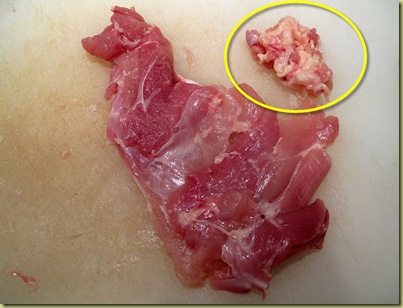
I am not a fan of chicken fat and trim as much from the chicken as possible. The first and second photos (below) show the before and after trimming. I prefer that the little pile of fat ends up in the trash rather than in our veins.

Another technical note:  Turn on the exhaust fan.  If you have a recirculating kitchen fan, open a window.  This recipe is aromatic and can generate a bit of smoke.

The final technical note:  I’m not sure what sort of wine to suggest with this meal.  Perhaps a harder liquor is in order.  Although alcohol is not permitted in Muslim households, I know they have alcohol in Casablanca, since I saw the movie at least a couple of times.

The recipe . . .

8 boneless/skinless chicken thighs
salt
garlic powder
black pepper
cinnamon
cardamom
paprika
cumin
ground red pepper (cayenne)
sugar
3 tablespoons olive oil

What?  No quantities?  No, just sprinkle the chicken evenly with spices. Be generous. The quantity of each spice is about the same, except be sparing with the cayenne pepper. Arrange the chicken, spiced side facing the pan. Heat the olive oil in a large skillet to medium heat and sprinkle more spices over the bare side chicken. Sauté until the chicken is browned (nearly blackened in appearance; five or six minutes), reduce heat to medium and turn chicken. Cook another five or six minutes.

Serve with couscous and a side of steamed and lightly buttered carrots OR slices of zucchini. This is how I imagine I would make chicken tights if I was Moroccan.

Leftovers: This dish is ideal for leftovers. Simply place into a skillet with the couscous, add a couple tablespoons of water, cover and heat on low heat until warm. Remove cover, turn up the heat to medium and cook until the liquid has evaporated.

Couscous

I like to use the large “pearl” couscous. Lightly brown couscous in 3 tablespoons of olive oil in a skillet. Add one diced onion and water (or chicken broth)(quantity per instructions on package), one (Knorr’s) vegetable bullion, ¼ teaspoon (or more) of garlic powder, salt, 1-1/2 tablespoons butter, and one finely diced carrot. Cover and cook over low heat until couscous is tender. Remove cover, increase heat to medium and sauté over moderately high heat until slightly browned, stirring often.

Zucchini

Slice ¼” thick on an angle. Push aside chicken once it is near the end of the cooking time and arrange zucchini slices in skillet. Cook for 4 minutes per side.

IMG_2472w

Chicken, ready to be cleaned of fat

img_2473w2

Chicken, cleaned of fat.  Note the 2 tablespoons of fat removed (circled)

Monday, July 13, 2009

Black Bean, Corn & Tomato Salsa

Carolyn made this for her birthday party, 7-12-05. It was a hit.

2 cans black beans
1-1/2 cups chopped seeded tomato
¾ pkg. frozen corn
½ cup chopped fresh cilantro, plus springs for garnish
1 red onion, diced
1 lemon (juice)
1 lime (juice)
½ cup olive oil
1-1/2 teaspoon salt

Drain the beans and tomatoes and in a bowl combine them with the corn, red onion, and the minced coriander.

In a small bowl whisk together the oil, the lemon juice, and the salt, pour the dressing over the and stirring to mix. The salad may be made 1 day in advance and kept covered and chilled. Serve the salad, garnished with the cilantro sprigs, at room temperature or chilled slightly.  Keeps for several days.

White Trash Nachos

We first discovered White Trash Nachos at the Silver Cloud Bar & Grill (1700 N. Damen Avenue), in Bucktown.  The recipe is very simple and devilishly tasty.  I first prepared this for Carolyn’s 7-12-09 birthday party using our End of Millennium Chili recipe.

2 bags Fritos
1/2 lb. shredded “Mexican cheese” (50/50 Colby and Monterey Jack)
Chili (about 4 or 5 cups)

Place contents of 1-1/2 bags of Fritos into a 9 x 12 baking dish.  Top with chili, spreading evenly with a spoon.  Cover with cheese.  Place under a broiler, just long enough to melt the cheese.  Serve.

Below, the Redneck Fire Alarm

Redneck Fire Alarm

BBQ Ribs

I first made these ribs for a July 4, 2003 lunch for Carolyn, Natalie and Julia.  This year I served them for Carolyn’s birthday party, accompanied by White Trash Nachos, and Black Bean, Corn & Tomato Salsa.  As you can see in the photo, I like to cut the ribs up and serve them on a platter.

2 to 6 slabs of baby back pork ribs
Can of spray olive oil

Rib Rub

2 tablespoons salt
4 tablespoons sugar
2 tablespoons ground cumin
2 tablespoons freshly ground black pepper
2 tablespoons chili powder
4 tablespoons paprika
1 tablespoons ground chipotle chili pepper

Basting Sauce

1-¾ cups apple cider vinegar
2 tablespoons Tabasco
2 tablespoons sugar
1 tablespoons salt
1 tablespoons freshly ground black pepper
2 tablespoons maple syrup (warmed, or it won’t mix)
2 tablespoons ketchup

Remove ribs from refrigerator and allow them to reach room temperature.

Spray ribs with oil and generously sprinkle with the dry rub.  Turn and repeat.  The point is to get as much of the rub mixture to stick as possible.  With the concave side facing down, spray the ribs with olive oil and apply another coating of rub.  And repeat a third time.

  • Set the grill to high for 10 minutes
  • Carefully place the ribs on the grill, concave side facing up. Reduce heat to lowest setting (on my DuKane grill this means turning the right burner off and setting the left burner to "low") and close cover. Cook 45 minutes.
  • Open cover and baste. Carefully turn the ribs, baste this side, cover and cook another 30 minutes.
  • Baste again. Cover, but this time keep the cover slightly open to vent some of the heat (about an inch or two). Cook another 30 minutes and baste.
  • Again cover, leaving the lid slightly open and cook 20 minutes.

Remove from grill, cut into individual pieces and serve.  Wet sauce is optional.

Saturday, May 9, 2009

Coddled Eggs

IMG_6215w

Tomorrow is Mother's Day, but we're taking the mom in this house out for brunch.  Since there will be no elaborate breakfast served and as a consolation prize, I made Coddled Eggs for Carolyn this morning (eve of MD).  I had never made coddled eggs before, so this was somewhat of an experiment (that turned out beautifully).  The egg yolks were wonderfully runny and the whites soft but cooked through.  I served the eggs with hashbrown potatoes and naan (Indian flat bread) with butter and jam.

Before I get to the recipe, let' ask ourselves the question I did, before making breakfast:  "What are coddled eggs?"  In short, these are eggs that are very gently cooked, in water that is just below the boiling point.  See Wikipedia's description HERE. 

In my version, I used two small ramekin dishes in a covered pan.  I coated one with vegetable oil, but not the other.  The result of that experiment was that the eggs were identical.  You will find, after turning out the eggs, that bits of egg remains stubbornly attached to the sides and bottom of the ramekins.  Don't despair.  Simply use a soapy abrasive cleaning pad (i.e. one of those green pads) and the egg matter will come off easily.

There are other options beside ramekins:  Special coddling dishes (see photo below), although I just view this as just more stuff you don't know cluttering up your kitchen. 

4 eggs
vegetable or olive oil (optional)

Place ramekins in a pot and add water to 1/2" below the rim of the ramekin.  This is done just to correctly guage the amount of water to use in the pan. Remove ramekins.

Crack two eggs into each ramekin. (You can add salt and pepper at this point, or even herbs or spices, but I did not.)  Heat the water to boiling and reduce heat somewhat.  Add the ramekins with eggs and cover.  Cook for 6 (to 10) minutes.

Carefully remove the ramekins (careful! They will be hot) and turn out on pre-warmed plates.  Served with toast and whatever accompaniment you desire. 

Side note:  The 100 pleats on a French master chef's toque (hat) represent the 100 different ways that he knows to prepare eggs.  I have a long way to go.

IMG_6210w

Eggs ready to be placed in barely boiling water.

Coddling dishes

Special coddling dishes, if you have money to burn and space in your cabinet.

IMG_6217w

Carolyn liked it!

Friday, May 8, 2009

Chicken Tetrazzini

Click on images to view larger version.

IMG_6206w

This recipe makes use of lots of butter.  Not for the faint of heart.  On the flip side, it makes 12-servings.  You can always opt cut everything by half, but it takes just as long to prepare this meal.  The dish is almost creamy in texture and deliciously rich and flavorful.  Of course it is . . . it has more than a stick of butter in it! 

1 lb. cooked thin spaghetti
4 cups rotisserie chicken (i.e. one chicken), pulled off the bone and cut into bite sized pieces
1 lb. fresh mushroom, cleaned and sliced (an extra half lb. won't hurt)
9 or 10 tablespoons unsalted butter
1/2 cup flour
2 teaspoon salt
1 tsp. black pepper
¼ teaspoon nutmeg (freshly ground if possible)
½ teaspoon garlic powder
1 teaspoon onion powder
1 tablespoon parsley (dried or fresh, finely chopped)
1 tablespoon thyme, dried
4 cups    whole milk
1/2 cup white wine
1 cup grated Parmesan cheese

Butter a large (9" x 12") casserole dish.

In a 12” skillet, over medium heat, saute sliced mushrooms lightly in 1 or 2 tablespoons butter.  Mushrooms should be slightly limp.  Remove mushrooms from skillet, including any liquid.

Melt remaining butter in pan and stir in the flour.  Cook on a medium flame, stirring constantly.  Add the salt, pepper, garlic powder, and onion powder.  Cook until bubbly.  Stir in the milk and continue cooking until the liquid thickens (stirring constantly).  Bring to a boil for one minute (turn up heat if necessary), stirring constantly.  Stir in the wine, chicken, and mushrooms and mix well.  Pour into casserole dish and cover with the cheese.  Bake in a 400ºF oven for 25 minutes and conclude by broiling so the top browns slightly.

Serve with garlic bread and a side dish of vegetables.  Or just eat it straight out of the casserole. 

Note:  Instead of garlic and onion powder, an option is to use 1 large onion, finely diced (or grated) and 5 cloves of garlic, minced.  Add at the end, with the mushrooms.

IMG_6138w 

Slice mushrooms medium thickness.

IMG_6148w

Cook in 1 or 2 tablespoons butter until limp

IMG_6150w

Butter mixed with flour in skillet.  Stir continuously until bubbly.

IMG_6163w

12 servings.  Good for a crowd or lots of leftovers.  Reheat in microwave.  About 1.5 minutes for a serving or two.  Even better, melt a bit of butter and reheat in a skillet, covered.  At the end, crank up the heat to caramelize the bottom.